Low-Stress Training: A Simple Home Tutorial for a Flatter, Fuller Canopy
Left to its own devices, a cannabis plant grows like a Christmas tree: one dominant central cola reaching for the light, everything else shaded out below. That shape works in a field with the sun moving overhead all day. Under a single fixed light in a tent, it wastes most of your canopy. The top gets blasted while the lower branches sit in shade, never bulk up, and finish as fluffy little popcorn buds that barely fill a jar.
Low-stress training, or LST, is the gentle fix, and it is one of those rare techniques that costs almost nothing and pays back nearly every time: growers who track it before and after commonly report yield gains in the 20 to 50 percent range over the same genetics left untrained. You bend the plant instead of cutting it. You persuade it to grow wide and flat so light reaches far more of it. No special gear, no recovery time, no real risk. Here is how to do it, written for adults growing where it is legal.
Why bending works
The plant runs on a hormonal pecking order. The highest growing tip floods itself with hormones that keep it dominant and quietly suppress the side branches below, a phenomenon called apical dominance. It is the same instinct that makes a forest tree race straight up to beat its neighbours to the canopy. Useful in the wild; counterproductive in a box with one lamp.
When you bend that top down so it is no longer the highest point, you interrupt the signal. Auxins, the hormones driving that vertical push, redistribute toward the bend, and the lower side branches stop being held back. Freed from suppression and suddenly sitting in good light, they surge upward and try to become colas in their own right. You end up with several strong, evenly fed shoots instead of one tall one and a crowd of runts beneath it.
The elegance is that you do all this without a single cut. There is no open wound, no week of sulking while the plant recovers, and far less that can go wrong than with topping, fimming, or other high-stress methods. You are simply redirecting growth the plant was always going to make.
Note. LST and "high-stress training" like topping are not rivals; plenty of growers top once for two main stems, then use LST to spread everything flat. But if you only ever learn one canopy technique, bending is the safer place to start.
What you need
You almost have most of this already.
- Soft, plant-safe ties. Foam-coated garden wire is the favourite because it holds a shape and never bites. Soft plant twist ties or strips of an old cotton t-shirt work too. Avoid thin bare wire, fishing line, or string, all of which can cut into a swelling stem as the season goes on.
- Something to anchor to. Drill or punch a ring of small holes around the rim of a fabric or plastic pot, or push a few short bamboo stakes into the soil. Either gives you tie-down points wherever you need them.
- A young, flexible plant. The single most important ingredient. The best moment to start is early vegetative growth, while stems are still green and rubbery. Wait too long and they turn woody and snap.
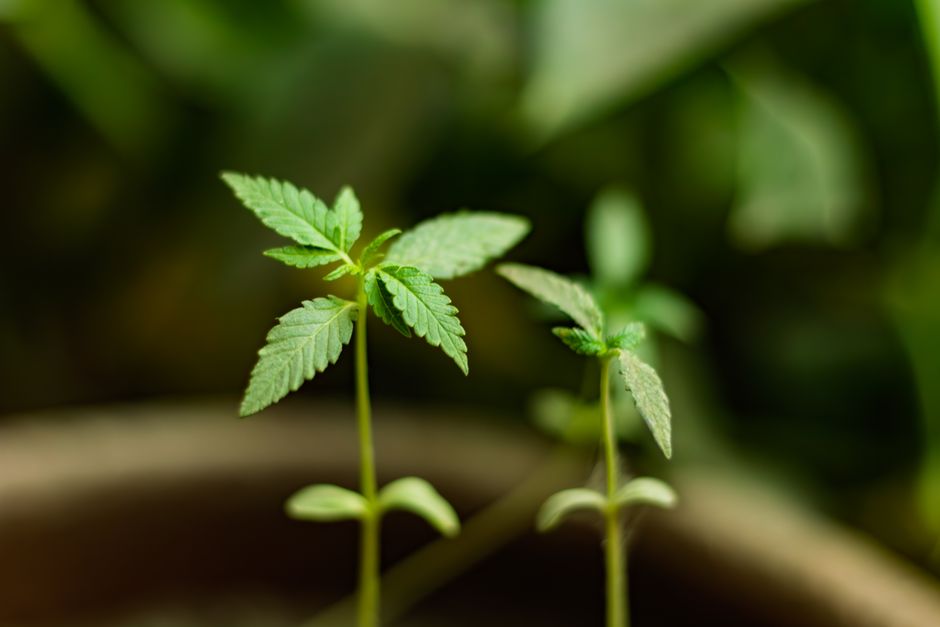 El doblez se sujeta, no se aprieta: la atadura mantiene la forma sin morder el tallo.
Step by step
1. Start while it is bendable. Begin once the plant has 3 or 4 sets of nodes and the main stem is still supple and green. The squeeze test is simple: if a stem flexes easily between your fingers, it will bend; if it feels stiff and cracks at the surface, you have left it a touch late. This is the same patience-over-the-calendar logic that pays off when you are transplanting seedlings without the shock — you read the plant, not the date.
2. Bend the main stem down and to the side. Gently ease the top over toward the edge of the pot, aiming for something close to a 90 degree bend, until it sits roughly level with the side branches rather than towering above them. Bend slowly, in stages, and feel for the point where the stem starts to resist. Stop there. You can always coax it a little further tomorrow.
3. Tie it in place. Anchor the top with a soft tie to the pot rim or a stake. The job is to hold the bend, not to choke the stem, so leave a little slack and check that nothing is digging in. A loop that fit comfortably 7 days ago can turn into a tourniquet as the stem fattens, which is why you keep an eye on every tie you leave on.
4. Let the lower branches rise. Over the next 3 to 5 days the side shoots will turn upward, reaching for the light now that nothing is shading them. As they climb, keep gently spreading them outward and tying them down too, so the whole plant flattens into an even, open fan. Think of it as building a table: you want a flat surface of growing tips all at a similar height.
5. Keep adjusting. LST is never one-and-done. As the plant grows you keep tucking, spreading, and re-tying new growth to hold that flat canopy where every shoot gets a fair share of light. A quick look every 2 or 3 days is plenty; 5 minutes here and there beats one heroic session.
If you can put your hand flat over the canopy and most of the growing tips brush your palm at about the same height, you are doing it right.
Reading the canopy as it fills in
Once the side branches are up and competing, your eye does most of the work. You are watching for tips that race ahead of the rest, and gently bringing them back down level. You are also looking underneath: any growth so deep in the shade that it will never amount to anything is a candidate for a light tuck outward, or for removal later if it is buried.
Even, generous light is the whole point of the exercise, and check back on the whole canopy every 2 to 3 days, and it pairs with everything else you are doing for the plant. A flat canopy that catches the lamp properly is wasted if the roots are struggling, so the same restraint that beats overwatering applies here: train the shape, then let the plant get on with growing into it.
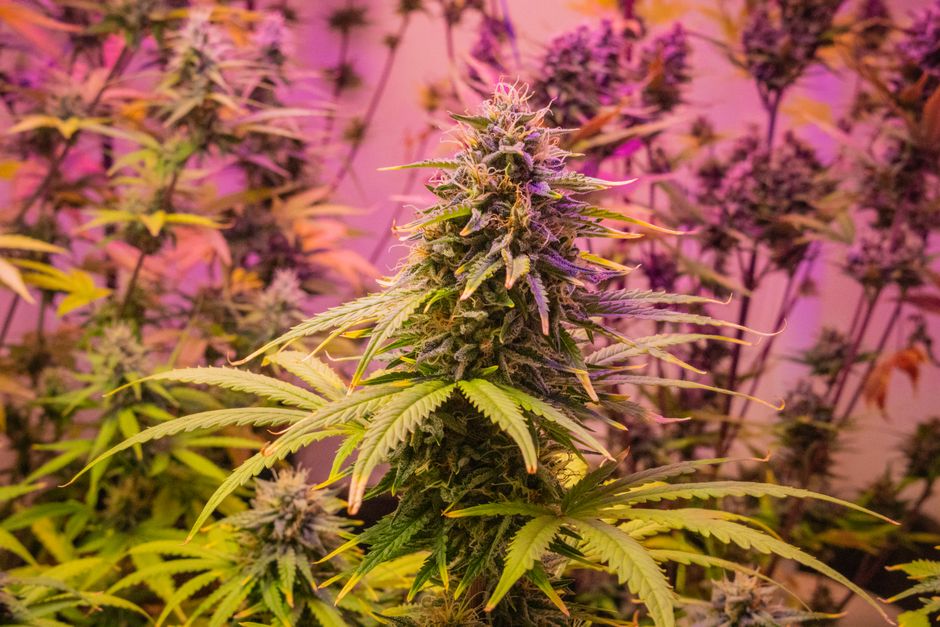 El objetivo: una mesa plana de cogollos, todos a la misma altura y todos recibiendo luz.
When a stem partly snaps
It happens, especially the first few times, and it is far less of a disaster than it feels in the moment. If you bend too far and a stem cracks but stays attached, do not panic and do not cut it off. Cannabis is remarkably resilient. Tape the break gently to support it, keep that branch stable for 1 to 2 weeks, and it will usually heal at the join. More often than not it forms a thicker, stronger knuckle right where it broke, and that branch carries on as if nothing happened. The plant is tougher than nervous first-timers expect.
When to ease off
Do the bulk of your training during vegetative growth and the early "stretch" of flowering, when the plant roughly doubles in height in the first 2 to 3 weeks after the light flip. That stretch is your last good window to set the final shape. Once flowers are forming and bulking up, stop wrestling the plant. Flower-heavy branches turn brittle, and a snap late in the cycle costs you real bud. By then the work is done; you are just maintaining the structure you built and, at most, tucking the odd leaf out of the way of a bud site.
Autoflowers are a slightly different game
If you are running autoflowers, the timing is tighter and the stakes for getting it wrong are higher, because an autoflower will not wait for you to recover from a setback. Start gentle and start early, while the plant is small and pliable, and keep the bends soft. A photoperiod plant can sit in veg for an extra 1 or 2 weeks to bounce back from rough handling; an autoflower is already on its way to flower whether you are ready or not. Knowing which type you are growing changes how aggressive you can afford to be, which is one of many reasons it pays to settle the feminised-versus-autoflowering question before the seed ever goes in the soil.
The payoff
Done well, LST turns one tall, light-hungry cola into a broad table of evenly lit shoots, every one of them able to fatten up into something worth jarring. It asks for a few minutes every couple of days and nothing but soft ties and a bit of patience. Beginners often reach for expensive lights or extra nutrients to chase bigger harvests when the cheapest gain is sitting right in front of them: spread the plant out so the light you already have actually lands on flower. For the effort involved, few things a home grower can do give back more.